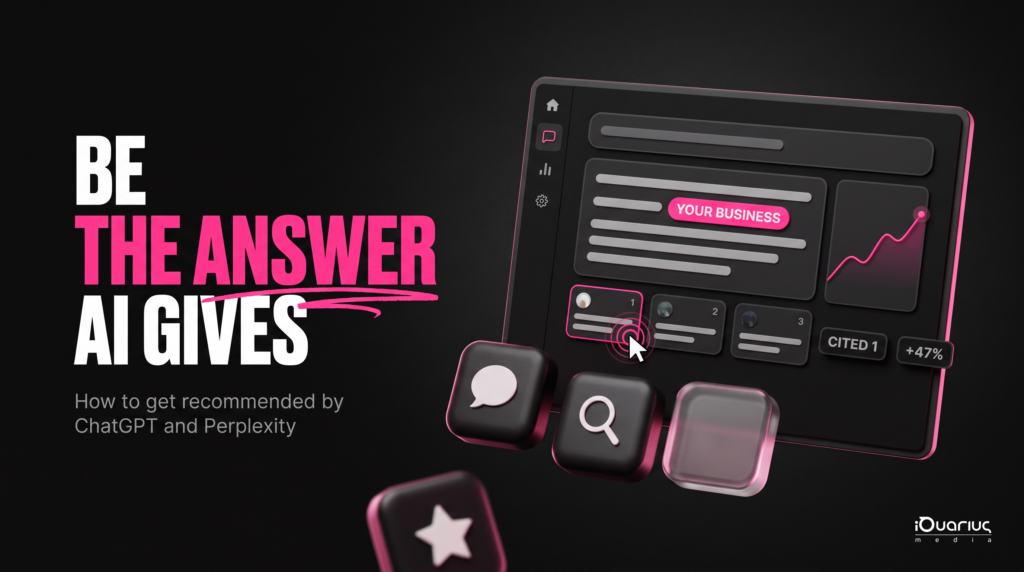
To get your business recommended by ChatGPT and Perplexity, you need to be described favourably on the third-party sources those models trust: review platforms, industry directories, editorial roundups and public data about your company. AI assistants do not rank your website. They summarise what other credible sources say about you, then name a shortlist.
That distinction changes the work. Traditional SEO asks how you rank for a query. AI recommendation optimization asks whether an assistant has enough consistent, verifiable evidence to say your name out loud when a buyer asks for a recommendation.
How ChatGPT and Perplexity Actually Choose Who to Recommend
Both systems answer recommendation questions in a similar way, even though their architectures differ. They retrieve a handful of sources, weigh them, and generate a short answer naming two to six businesses.
Perplexity is the more transparent of the two. Every answer shows its citations, so you can see exactly which pages produced the recommendation. ChatGPT with browsing behaves similarly, while its base model also draws on patterns learned during training, which favours businesses mentioned consistently across the open web over a long period.
In practice, three signal types drive most recommendations:
- Third-party citations — being named in listicles, comparison posts, industry publications and directory pages that AI crawlers already trust.
- Review signals — volume, recency, rating and, critically, the language inside the reviews themselves.
- Entity consistency — your name, services, location and specialism described the same way everywhere the model looks.
Your own website matters, but mostly as corroboration. It confirms what the other sources claim. It rarely creates the recommendation on its own.
Start With the Prompts Your Buyers Actually Type
Most businesses guess at this. You do not need to. Open ChatGPT and Perplexity and run the real buying prompts for your category, then record who gets named and which sources are cited.
Useful prompt patterns to test:
- “Best [service] company for [specific customer type]”
- “Who should I hire for [problem] if I have a budget of [amount]?”
- “[Competitor] alternatives”
- “Is [your company] any good?”
- “Compare [your company] and [competitor]”
Run each prompt three or four times. Answers vary between sessions, so a single test tells you very little. What you want is the pattern: which businesses appear repeatedly, and which URLs the models keep pulling from.
That list of cited URLs is your target list. If a comparison article on a trade publication is cited in four out of five answers and you are not in it, you have found a concrete, fixable gap.
Check What the Models Already Say About You
Ask directly: “What do you know about [your company]?” The answer reveals how the models have categorised you. Common problems include an outdated service list, the wrong location, a confusion with a similarly named business, or a flat refusal because there is not enough public information.
Each of those has a different fix. Misinformation is usually a source problem. Silence is usually a coverage problem.
Build the Third-Party Citations That Trigger Recommendations
This is the mechanism most businesses skip. AI assistants recommend businesses that independent sources have already recommended. Your job is to earn those independent mentions.
- Get into the roundups that already rank. Search “best [your category]” and note the articles on page one. These are frequently the exact pages Perplexity cites. Contact the publishers with a clear, factual case for inclusion.
- Claim and complete every relevant directory profile. Industry associations, chamber listings, software marketplaces and vertical directories are heavily crawled and highly structured, which makes them easy for models to parse.
- Publish original data. A survey, benchmark or annual report gives journalists and bloggers a reason to cite you by name. Cited statistics carry your brand into answers about the topic, not just answers about your category.
- Contribute expert commentary. Quotes in trade press attach your name to a specific area of expertise, which is how models learn what to recommend you for.
- Appear on podcasts and webinars with written show notes. Audio is not crawlable. The transcript and description are.
Quantity helps, but consistency helps more. Ten sources describing you the same way outperform forty that describe you differently.
Reviews Are the Strongest Single Signal You Control
Review platforms are structured, frequently updated and explicitly evaluative, which makes them ideal source material for a recommendation engine. When a model needs to justify naming a business, review content is the easiest evidence to summarise.
What matters is not just the star rating:
- Recency. Reviews from the last 90 days weigh more than a burst from three years ago.
- Specific language. A review saying “they rebuilt our lead tracking in six weeks” gives a model something concrete to quote. “Great service” gives it nothing.
- Spread across platforms. Google, industry-specific sites and marketplace profiles each get retrieved for different queries.
- Owner responses. They add context, confirm details and demonstrate an active business.
Ask satisfied clients to describe the specific problem you solved and the outcome. That single change in how you request reviews does more for brand visibility in AI search than most on-site tactics. This is where reputation management stops being defensive and starts producing measurable acquisition value.
Make Your Own Content Easy for AI to Quote
Your website will not usually create the recommendation, but it will often confirm or contradict it. Structure it so a model can extract facts without ambiguity.
- Answer questions directly in the first two sentences of a page or section, then support the answer.
- State specifics. Pricing ranges, service areas, industries served, team size, typical timelines. Vague positioning gives a model nothing to work with.
- Use clear headings phrased as the questions buyers ask.
- Add Organization, Service and FAQ schema so your core facts are machine-readable.
- Maintain a comparison page covering how you differ from named alternatives. Models retrieve these constantly for “X vs Y” prompts.
- Keep a current about page with founding date, leadership, locations and credentials.
This is technical and editorial work at the same time, which is why it sits inside a modern SEO service rather than alongside one. The same crawlability, structure and authority signals that support rankings also determine whether an assistant can safely name you.
Do Not Block the Crawlers That Matter
Check your robots.txt. Some sites block GPTBot, PerplexityBot, ClaudeBot or CCBot without realising it, often through a default setting or a plugin. If you block them, you cannot be retrieved, and no amount of content work will change that.
How Long This Takes and What to Measure
Perplexity responds fastest because it retrieves live. New citations can influence its answers within days or weeks. ChatGPT’s browsing mode behaves similarly, but its underlying model knowledge updates on training cycles, so brand-level recognition builds over months.
Track four things:
- Mention rate. Across your top 20 buyer prompts, in what percentage of answers are you named? Measure monthly, several runs per prompt.
- Citation sources. Which URLs do the models pull when they recommend you? Those pages deserve ongoing attention.
- Referral traffic. Filter analytics for chatgpt.com and perplexity.ai. The volume is usually modest. The conversion rate rarely is, because the visitor arrives pre-qualified by a recommendation.
- Answer accuracy. Is the description of your business correct? An inaccurate mention can cost you more than no mention.
A realistic first target is moving from zero mentions to appearing in roughly a third of answers for your priority prompts within two quarters. That requires sustained citation building, not a one-off push.
Capture the Leads AI Sends You
Getting recommended is half the work. Traffic from AI assistants behaves differently from search traffic: fewer visitors, higher intent, and a buyer who has already been told you are a credible option. These people often arrive ready to talk, not ready to browse.
That places pressure on what happens after the click. Response time, a clear next step, a working booking flow and a way to track which conversations started in an AI answer all determine whether the recommendation turns into revenue.
iQuarius Media is built around this end to end. We are an ROI-focused digital marketing agency powered by AI, which means the same team that earns the citations also builds the system that captures the leads those citations produce, through our iQComms platform. The strategy and the infrastructure stay in one place.
The Short Version
If you want to know how to get recommended by ChatGPT and Perplexity, work in this order:
- Audit the real buyer prompts and record who gets named and why.
- Fix any inaccurate or missing information about your business.
- Earn placements in the third-party sources the models already cite.
- Build recent, specific reviews across multiple platforms.
- Structure your site so its facts are extractable and its crawlers are unblocked.
- Measure mention rate monthly and keep the citation work going.
None of it is exotic. It is authority, accuracy and consistency, applied to a new set of readers who happen to be machines summarising on behalf of your next customer.