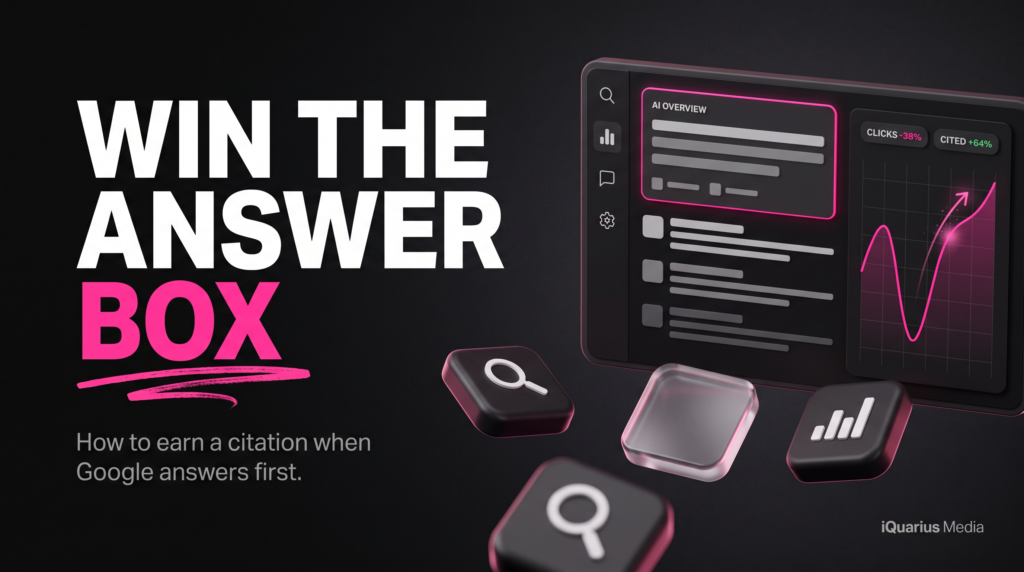
To get your content featured in Google AI Overviews, publish pages that answer a specific question directly in the first 40 to 60 words, back the answer with concrete detail, and earn enough authority to be a trusted source. Google pulls from pages it already trusts, so clear structure plus topical depth is what gets you cited.
That is the short version. The longer version matters, because AI Overviews have changed how much traffic a good ranking is actually worth.
What Are Google AI Overviews?
Google AI Overviews are AI-generated summaries that appear at the top of the search results page, above the traditional blue links. Google reads several pages, synthesises an answer, and cites the sources it used with links.
They started as Search Generative Experience, or Google SGE, an opt-in experiment. That experiment became a default feature, and by 2026 AI Overviews appear on roughly 48% of queries. Informational searches trigger them most often, which is exactly where most service businesses do their content marketing.
Three things are worth understanding about how they behave:
- They appear most on question-style and research queries, less on transactional ones.
- They cite multiple sources, usually three to eight, not just the top result.
- The sources cited are not always the pages ranking highest for that keyword.
AI Overviews Traffic Impact: Why Your Numbers Dropped
If your rankings held steady but your clicks fell, you are seeing the AI Overviews traffic impact firsthand. The result is still there. Fewer people are scrolling past the summary to reach it.
The pattern is consistent across industries. Informational queries lose the most clicks, because the AI Overview answers the question outright. A searcher asking “how much does a roof replacement cost” often gets a workable number without leaving Google.
Commercial and local queries hold up better. Someone searching “roof replacement near me” or “HVAC contractor in Tampa” still needs to pick a business, check reviews, and make contact. AI cannot do that part for them.
What This Means for Service Businesses
If you run a local or service-based business, your traffic mix probably shifted rather than collapsed. The top-of-funnel educational posts took the hit. The pages tied to hiring decisions, pricing, service areas and comparisons likely held.
The practical response is not to abandon informational content. It is to write it so you get cited, and to make sure the money pages behind it are strong enough to convert the smaller, more qualified stream of visitors that still arrives.
Featured Snippet vs AI Overview: What’s the Difference?
The featured snippet vs AI Overview distinction confuses a lot of people, because they occupy the same real estate and look similar at a glance. They work differently.
- Featured snippets pull a verbatim block of text from one page. One source, quoted directly, with a link.
- AI Overviews generate new text by combining information from several pages. Multiple sources, paraphrased, each with a citation link.
The practical difference is where the opportunity sits. A featured snippet is winner-take-all: one page gets the position. An AI Overview cites several sources, so more pages can appear, but each one gets a smaller share of attention.
The optimisation work overlaps heavily. Content structured to win featured snippets, meaning direct answers, clean headings and tight paragraphs, is also the content AI Overviews prefer to cite. You are not choosing between the two formats. You are writing for both.
Do I Need to Rank in the Top 10 to Appear in AI Overviews?
No, and this is the part most coverage skips. Studies of AI Overview citations consistently find that a meaningful share of cited pages do not rank in the top 10 for the query that triggered the overview. Some do not rank on page one at all.
Google is not simply lifting the top results. It is selecting passages that answer the specific sub-question it is addressing. A page ranking 14th that contains a clearer, more precise answer to one part of the query can be cited over a page ranking 3rd that covers the topic more broadly.
That creates a real opening for smaller businesses. You may not outrank a national directory or a large competitor on domain authority. You can still write a more useful, more specific answer to a narrow question, and get cited for it.
Ranking still helps. Pages in the top 10 are cited far more often than pages outside it. But the barrier is lower than the old first-page-or-nothing model, especially for long-tail and local queries where competition is thinner.
How to Appear in AI Overviews: Seven Practical Steps
Here is what actually moves the needle on how to appear in AI Overviews. None of it is exotic. It is disciplined content structure applied consistently.
- Answer the question in the first paragraph. Give a complete, standalone answer in 40 to 60 words before you elaborate. AI models extract answers, not build-ups.
- Use question-based headings. Turn your H2s and H3s into the actual questions people ask. This maps your page structure to how AI parses content.
- Keep paragraphs short. Two to four sentences. Each paragraph should make one point that could stand alone if quoted.
- Include specifics. Numbers, timelines, price ranges, named processes and step counts. Vague content gets skipped in favour of pages that commit to concrete detail.
- Add structured data. FAQPage, HowTo, Article and LocalBusiness schema help Google understand what your content contains and who published it.
- Demonstrate real expertise. Named authors, credentials, original data and firsthand experience. Google weights source trust heavily when deciding what to cite.
- Build topical depth. A single post rarely earns citations. A cluster of connected pages covering a topic thoroughly signals that you are a legitimate source on it.
AI Overview Optimization for Local and Service Businesses
Local search has its own layer. AI overview optimization for a plumber, clinic or law firm should lean on the signals AI systems use to establish local relevance.
- Keep your Google Business Profile complete, accurate and active.
- Publish location-specific pages with genuine local detail, not city names swapped into a template.
- Answer the questions your customers actually ask on the phone. Those are your citation opportunities.
- Maintain consistent name, address and phone details across directories.
- Encourage reviews that mention specific services, which strengthens the connection between your business and those service terms.
What to Measure Now That Clicks Tell a Smaller Story
Traditional traffic reporting no longer captures your full search performance. Impressions can rise while clicks fall, and that is not automatically a failure.
Track these alongside sessions:
- Impressions and average position in Search Console, to confirm visibility is holding.
- Click-through rate by query type, so you can separate informational decline from commercial performance. Falling AI Overviews click through rate on educational queries is expected; falling CTR on service and location queries is not.
- Branded search volume, which often rises when you are being cited even if clicks do not.
- Conversion rate, which frequently improves as casual traffic filters out and buyers remain.
- Citation appearances, checked manually or with a tracking tool, for your priority queries.
Judging AI Overviews SEO by raw sessions alone will lead you to cut content that is still doing its job. Judge it by qualified visits and by whether your business is the one being named.
Where This Leaves Your Strategy
AI Overviews reward the same things good SEO always rewarded: clarity, specificity, structure and credibility. They just raised the penalty for vague content and lowered the reward for thin pages that ranked on keyword placement alone.
The businesses adapting well are treating AI systems as a second audience. A human reader needs context and persuasion. An AI system needs a clean, extractable answer. Well-built pages serve both without compromise.
At iQuarius Media, AI sits at the centre of how we work rather than off to the side. As an ROI-focused digital marketing agency powered by AI, we build content designed to be cited by AI systems and to convert the people who click through. If you want that applied to your site, our SEO services cover the structure, schema and topical depth that make it work.
Start with your five highest-value queries. Check whether an AI Overview appears, note who gets cited, and rewrite your page to answer the question more directly than any of them. That single exercise, repeated across your priority topics, is the most reliable way to rank in AI Overviews and hold your visibility as search keeps shifting.