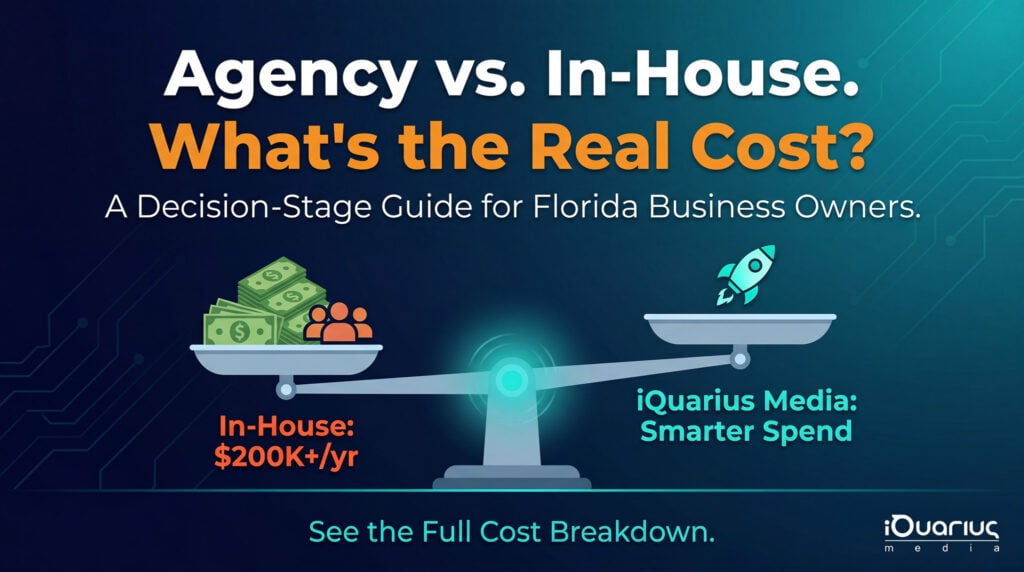
When a business reaches the point where marketing can no longer be handled informally, the first real strategic decision is who does the work. The instinct for many business owners is to hire — to bring someone in-house where they feel closer to the work and more in control of the outcome. That instinct is understandable, but it often leads to a decision made on incomplete information. The true cost of an in-house marketing team and the true cost of an agency relationship look very different once you account for everything.
This post is a direct, honest comparison. Not a pitch — a framework for thinking clearly about a decision with real financial consequences.
The In-House Cost Is Almost Always Underestimated
When business owners calculate the cost of hiring in-house, they typically start with salary. That’s the first miscalculation. Salary is the most visible number, but it’s not the whole number.
A mid-level marketing manager in Orlando with genuine digital competency — someone who can run paid campaigns, manage SEO, produce content, and report on performance — commands a salary somewhere between $55,000 and $75,000 annually in the current Florida market. Add employer payroll taxes (roughly 7.65%), health insurance contributions (typically $5,000 to $8,000 per year per employee), paid time off, and any retirement matching, and the fully-loaded cost of that single hire lands between $68,000 and $95,000 per year before a single dollar of marketing is spent.
That’s one person. One person cannot execute a full-service digital marketing program. They can manage some things adequately, but the moment the business needs serious paid media management, a website rebuild, a video production run, or a technical SEO audit, that single hire is either out of their depth or out of their hours. So the realistic in-house model for a business that wants comprehensive marketing coverage isn’t one hire — it’s two or three, plus freelancers and tools, plus the management overhead of coordinating all of it.
A realistic fully-loaded in-house marketing function for a Florida SMB — a marketing manager, a content or social specialist, and the software stack to support them (ad platforms, SEO tools, CRM, design tools, analytics) — runs $150,000 to $220,000 annually. That’s before ad spend. That’s the operational cost of the people and infrastructure needed to execute.
What an Agency Actually Costs — and What That Buys
A full-service digital marketing agency relationship for a Florida small business typically runs between $2,500 and $8,000 per month depending on the scope of services engaged. At the lower end, that covers foundational services — SEO, content, and social management. At the higher end, it includes paid media management, website support, email marketing, and reporting infrastructure.
Annualized, that’s $30,000 to $96,000 — a range that overlaps with and frequently comes in below the cost of a single qualified in-house hire, let alone a team.
What that agency retainer buys is not one person’s skill set. It buys access to a team of specialists — an SEO strategist, a paid media manager, a content writer, a web developer, a designer, an account manager — each operating in their lane with depth that a generalist hire cannot replicate. The business gets a bench, not a seat.
There’s also the tool stack to consider. A competent agency runs professional-grade SEO platforms, ad management software, analytics infrastructure, and reporting tools that would cost a small business $15,000 to $30,000 annually to replicate independently. That cost is absorbed into the agency’s overhead and spread across clients. The small business gets the capability without the individual licensing cost.
The Capability Gap Is the Argument Most Businesses Miss
Cost comparison is the easy part of this decision. The harder — and more consequential — part is the capability question.
Digital marketing in 2026 is not one skill. It’s a constellation of disciplines that each require genuine expertise to execute well: technical SEO, paid search management, conversion rate optimization, content strategy, marketing automation, analytics and attribution, social media strategy, web development. A person who is genuinely excellent at all of these simultaneously does not exist. People who claim to be are either exceptional at one or two and adequate at the rest, or they’re overstating their range.
When a business hires a single in-house marketer, they’re getting one person’s ceiling across all of those disciplines. When they engage a full-service agency, they’re getting specialists in each. For businesses operating in competitive markets — and Orlando is a competitive market across most service categories — the difference between specialist execution and generalist execution is the difference between campaigns that move the needle and campaigns that generate activity reports.
This is the argument most business owners don’t fully weigh because it’s harder to quantify than salary. But consider what happens when your in-house marketer hits the limit of their paid media knowledge and your Google Ads account is burning $5,000 a month at a 4:1 cost-per-acquisition when a specialist could get it to 8:1. The capability gap is paying for itself in waste — it just doesn’t show up on a line item labeled “in-house limitation.”
Where In-House Actually Wins
An honest comparison acknowledges where in-house is genuinely the stronger model. Institutional knowledge is real. An in-house marketer who has been with the business for two years knows the customers, the culture, the sales team’s objections, and the brand nuances in ways that even a deeply engaged agency can’t fully replicate. For businesses where content strategy depends heavily on internal expertise — professional services, technical industries, businesses with complex proprietary products — that proximity matters.
Brand voice consistency is another legitimate in-house advantage. An internal content creator who lives inside the brand every day tends to produce more naturally on-voice work than an external writer, at least in the early stages of an agency relationship. This is a solvable problem with the right agency partner, but it takes intentional onboarding and ongoing collaboration, and it’s fair to acknowledge that the friction exists.
Speed of execution on reactive content — capitalizing on a news moment, responding to a market development, getting a campaign live quickly — can also favor in-house teams, simply because the communication chain is shorter.
The honest synthesis is that in-house and agency are not mutually exclusive. Many of the most effectively marketed businesses use a hybrid model: a single internal marketing coordinator who owns the brand relationship and manages internal stakeholders, paired with an agency that provides the specialist execution and strategic depth that a single hire can’t deliver alone. That structure gets the proximity benefits of in-house and the capability benefits of an agency without the full cost burden of building an internal team.
The Real Cost Comparison
Rather than burying this in prose, here it is directly:
In-House Marketing Team (Florida SMB, moderate scope)
- 1 Marketing Manager: $65,000–$75,000 salary
- Fully-loaded employer cost (taxes, benefits, PTO): add 25–35%
- Total for one hire: $82,000–$101,000
- Software stack (SEO, ads, design, CRM, analytics): $15,000–$25,000
- Freelance support for gaps (design, development, video): $10,000–$20,000
- Realistic annual total: $107,000–$146,000 for one person’s capability range
Full-Service Agency Relationship (comparable scope)
- Monthly retainer: $3,500–$7,000
- Access to multi-discipline specialist team included
- Tool stack absorbed into agency overhead
- Realistic annual total: $42,000–$84,000 for broader capability coverage
The numbers favor the agency model on pure cost in most SMB scenarios. The calculus shifts for larger businesses with the budget to build a genuine in-house team of three or more specialists — at that level, the institutional knowledge and brand proximity advantages of in-house start to outweigh the cost premium. But for Florida small and mid-size businesses operating with realistic marketing budgets, the agency model consistently delivers more capability per dollar.
Frequently Asked Questions
Is it cheaper to hire in-house or use a digital marketing agency?
For most Florida small businesses, a full-service agency relationship is less expensive than building a comparable in-house capability when you account for fully-loaded employee costs, software, and freelance support. The in-house model becomes cost-competitive at larger scale — typically when a business can justify three or more dedicated marketing hires.
What does a digital marketing agency typically cost?
Full-service agency retainers for Florida SMBs typically range from $2,500 to $8,000 per month depending on the scope of services. Project-based engagements — a website build, a campaign launch — are priced separately. Ad spend is always a separate budget on top of the management fee.
What are the advantages of outsourcing digital marketing?
The primary advantages are access to specialist expertise across multiple disciplines, a professional tool stack without individual licensing costs, scalability without the overhead of hiring, and an outside perspective that internal teams often lack. For businesses in competitive markets, specialist execution consistently outperforms generalist execution.
Can I do a hybrid of in-house and agency?
Yes, and for many businesses it’s the strongest model. A marketing coordinator or brand manager in-house handles internal relationships, brand stewardship, and reactive content, while an agency provides strategic depth, specialist execution, and reporting infrastructure. The two functions complement each other well when the division of responsibility is clear.
How do I evaluate whether an agency is actually delivering ROI?
Meaningful ROI measurement requires clear baselines before the engagement starts and agreed-upon KPIs tied to business outcomes — leads generated, cost per acquisition, revenue influenced — not just traffic and impressions. A reputable agency will establish these metrics at the outset and report against them consistently. If an agency can’t connect their work to business results, that’s a meaningful red flag.
When does it make sense to hire in-house instead of using an agency?
In-house makes the most sense when institutional knowledge and brand proximity are critical competitive factors, when the business has the budget for a genuine multi-person team, or when marketing execution requires deep, real-time integration with sales, product, or operations. For most Florida SMBs below $5M in revenue, the agency model provides better capability coverage at lower cost.
The agency versus in-house decision is ultimately not a cost decision — it’s a capability decision with cost implications. The businesses that get this right ask first what level of marketing execution their competitive environment actually demands, and then figure out the most efficient way to deliver it. For most Florida small businesses, that answer points clearly toward the agency model, at least until scale justifies the investment in a full internal team.
If you want to understand specifically what an agency relationship with iQuarius Media would cover, what it would cost, and what outcomes are realistic for your market — the conversation starts here.
“`