Artificial intelligence is no longer a futuristic add-on to your marketing stack. For small and mid-sized businesses, AI implementation is becoming the connective tissue between website traffic, CRM automation, and measurable growth. The question is no longer whether AI matters. The question is whether your business has the right formula powering it.
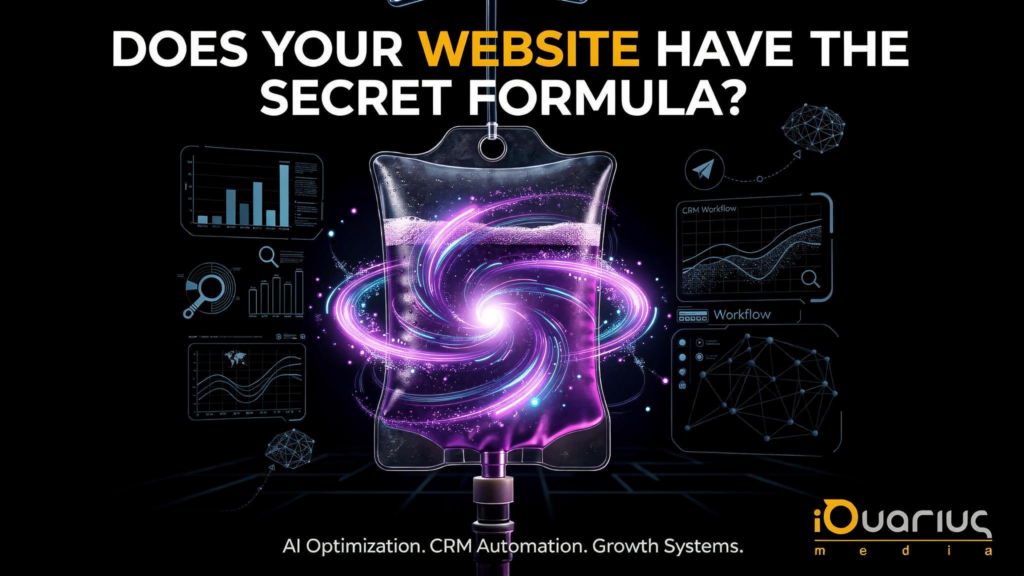
The visual theme of “the secret formula” is accurate. AI is not a single tool. It is a system of integrated data, automation, optimization, and workflow logic. When configured properly, it fuels your website, your CRM, and your marketing channels simultaneously. When misapplied, it becomes noise.
What AI Implementation Actually Means for a Business
AI implementation is often misunderstood as installing a chatbot or using a content generator. In reality, effective AI integration touches multiple layers of your infrastructure.
At the surface level, AI supports content optimization, search intent alignment, and dynamic personalization. At the operational level, it enhances lead routing, pipeline prioritization, predictive follow-up timing, and automated customer communication. At the strategic level, it supports decision-making through pattern recognition in analytics data.
For SMBs, AI should enhance three core areas: visibility, conversion, and retention. Anything outside those pillars is distraction.
AI visibility improvements may include search optimization alignment and structured content that performs in AI-driven search environments. Conversion improvements involve conversational lead qualification, intelligent routing, and predictive follow-up. Retention improvements rely on behavior-based automation and reactivation triggers.
When these layers are connected, AI stops being a feature and becomes a growth multiplier.
The Secret Formula: AI + CRM + Automation Working Together
The concept of a “secret formula” is not about mystery. It is about integration. AI by itself does not increase revenue. CRM systems by themselves do not increase revenue. Automation without structure does not increase revenue.
Revenue grows when AI insights feed into CRM workflows and automation executes consistently.
For example, AI-driven lead scoring can identify which inquiries are most likely to convert. That data flows into the CRM. Automated workflows then prioritize response sequences based on predicted conversion probability. Sales teams receive intelligent prompts rather than generic notifications.
Similarly, AI can analyze user behavior on landing pages and adjust messaging sequences automatically. When integrated with a CRM platform like iQComms, these insights are not siloed. They influence communication timing, follow-up strategy, and pipeline movement.
The formula is simple in theory: data intelligence + workflow automation + centralized CRM architecture. Execution is where most businesses fall short.
Practical AI Use Cases SMBs Should Be Deploying
Effective AI implementation does not require enterprise budgets. It requires strategic clarity.
One of the highest-impact use cases is conversational AI for initial lead qualification. Instead of a static contact form, AI-driven chat workflows can ask contextual questions, qualify the lead, and route it into the correct pipeline stage automatically.
Another strong use case is predictive follow-up timing. AI can analyze historical data to determine when prospects are most likely to respond and schedule outreach accordingly. This increases response rates without increasing manual effort.
Content AI is also powerful when guided correctly. AI-assisted content structuring can improve search alignment, answer-first formatting, and semantic coverage, increasing visibility in AI-driven search environments.
Within CRM systems like iQComms, AI can enhance task prioritization, automate segmentation, and trigger retention campaigns based on behavior signals. The key is orchestration. Tools must work together.
Avoiding the AI Hype Trap
The market is flooded with AI promises. Many businesses adopt multiple tools without a unifying strategy. This leads to fragmented data, inconsistent messaging, and operational confusion.
AI should reduce complexity, not increase it.
Before implementing new tools, businesses should audit their existing infrastructure. Is lead attribution tracked properly? Are pipelines clearly defined? Are follow-up sequences consistent? If the foundation is weak, AI will only amplify inefficiencies.
The goal is not to automate everything. The goal is to automate intelligently.
Building a Growth System, Not Just Using AI
AI implementation is not a campaign. It is infrastructure.
For service-based businesses competing in markets like Orlando and Naples, the combination of AI optimization, CRM automation, and structured growth systems creates a competitive advantage. Faster response times, smarter routing, stronger personalization, and measurable attribution become standard operating procedure rather than reactive adjustments.
When your website, CRM, automation workflows, and analytics dashboards are connected, growth stops being unpredictable. It becomes engineered.
That is the real secret formula.