Most business websites are underperforming, and the owners know it. The traffic is uneven, the conversions are inconsistent, and the gap between what the site is doing and what it could be doing keeps widening. What’s changed in 2026 is that closing that gap no longer requires an in-house engineering team or an enterprise software budget. AI website optimization has moved from a category dominated by large platforms into a set of practical tools and methods that any serious small business can use to make their site genuinely competitive.
This post is about what that actually means in practice — where AI is producing measurable results on small business websites, what’s worth investing in, and what’s still mostly marketing language wearing a technical badge.
The Shift From Static Site to Self-Improving System
For most of the past two decades, a small business website has been a static asset. You built it, you launched it, and it sat there doing whatever it was built to do until you decided to rebuild it years later. Optimization happened in periodic bursts — an SEO audit here, a redesign there — and the rest of the time the site just existed.
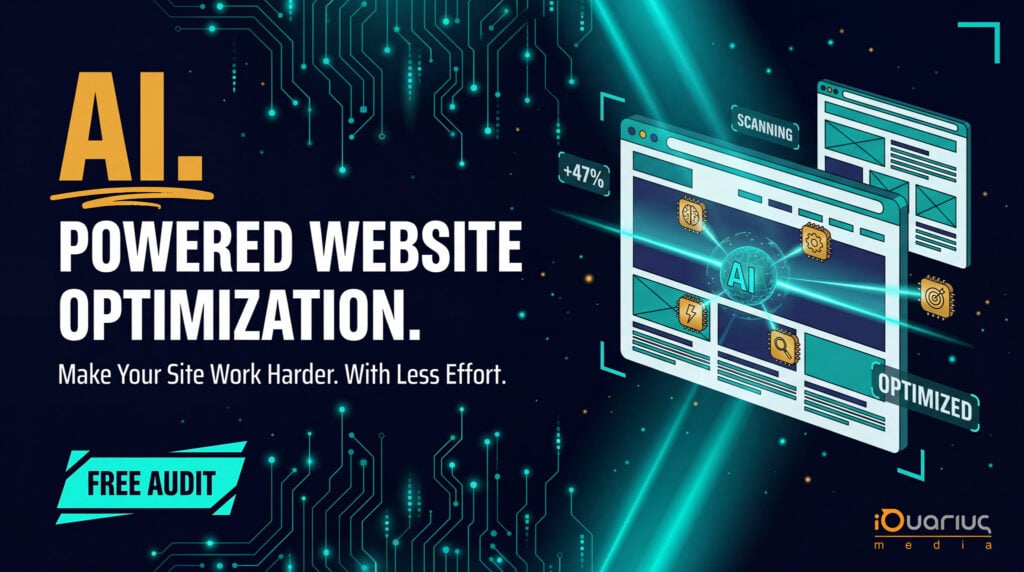
What AI has done to this model is collapse the gap between “the site is live” and “the site is being improved.” A well-implemented AI-driven website is continuously analyzing how visitors interact with it, identifying friction points, testing alternatives, and incorporating what wins. It doesn’t wait for a quarterly review. The improvements happen in the background while the business owner runs the business.
This is the real conceptual shift, and it’s the one most worth internalizing before evaluating any specific tool. The question is no longer whether your website is good. The question is whether your website is learning. A site that learns will outperform a static competitor over time even if it started at a disadvantage, because the cumulative effect of small, ongoing improvements compounds in a way that periodic redesigns never can.
Where AI Is Actually Moving the Needle
The applications of AI to website optimization that are producing real, measurable results for Florida small businesses fall into a few specific categories. Not everything labeled AI deserves attention. The areas below do.
Behavioral analysis and friction identification is the most foundational application. Tools using machine learning to analyze session recordings, scroll patterns, click behavior, and exit points can identify exactly where visitors are losing interest or abandoning conversion paths. What’s different about AI-driven behavioral analysis is the pattern recognition layer — instead of producing reports a human has to interpret, these tools surface specific problems and rank them by estimated revenue impact. A business owner doesn’t need to know how to read a heatmap. They need to know that 38% of mobile visitors are abandoning the contact form at the third field and that shortening it is likely to recover a measurable percentage of those lost leads.
Content optimization driven by AI has matured beyond first-generation writing tools into something more strategically useful. The valuable application isn’t generating content — it’s analyzing it. AI content optimization tools evaluate your existing pages against the top-ranking competitors for your target keywords, identify semantic gaps, flag content that doesn’t match search intent, and recommend specific structural improvements. For an Orlando business trying to rank for competitive local terms, this kind of systematic analysis replaces a guessing game with a targeted edit list.
Conversion rate optimization through AI-driven testing is where the math gets compelling fast. Traditional A/B testing requires substantial traffic to reach statistical significance, limits you to one variable at a time, and runs on timelines that don’t match how quickly markets change. AI-powered testing platforms can run multivariate experiments concurrently, personalize the experience for different visitor segments, and adapt in real time based on incoming data. A landing page receiving paid traffic from Google Ads or LSAs becomes a continuously improving asset rather than a static one — and the lift on conversion rate, even when modest in percentage terms, translates directly into reduced cost per acquisition across every paid channel feeding that page.
Page speed and performance optimization is the application most invisible to users but most measurable in ranking impact. Modern hosting platforms and CDNs use machine learning to predict which resources a visitor is likely to need next and preload them, compress images dynamically based on the visitor’s device and connection, and route traffic through the optimal infrastructure path. For a Florida business competing in mobile-heavy local search, where load time is both a ranking factor and a conversion factor, AI-driven performance tooling resolves a category of issues that most small business sites carry silently.
Personalization is the most advanced application and the one most often overpromised. Real AI personalization on a small business website doesn’t mean every visitor sees a fully customized experience — it means visitors arriving with different intent signals see content tailored to that intent. A first-time visitor from an Orlando organic search sees different headline copy and different trust signals than a returning visitor who previously viewed a specific service page. A visitor on mobile sees a different primary call-to-action than one on desktop. These adjustments don’t require a custom application — they require an intentional implementation of capabilities that increasingly come standard with modern CMS platforms.
AI SEO Tools: What’s Worth Using in 2026
The AI SEO tool landscape has gotten crowded fast, and a lot of what’s marketed as AI is closer to automation than intelligence. The distinction matters because the value scales with how much actual machine learning is operating under the hood versus how much is rule-based logic dressed up in current vocabulary.
The tools producing genuine value share a few characteristics. They’re connected to live search data and can identify ranking opportunities based on real-time SERP analysis. They produce specific, prioritized recommendations rather than generic checklists. They learn from the changes you implement and update their guidance accordingly. And they integrate technical SEO, content analysis, and competitive intelligence in a way that surfaces non-obvious opportunities — the keywords your competitors rank for that you haven’t targeted, the topical clusters where you have authority gaps relative to your market, the technical issues that are suppressing pages that should otherwise perform well.
For an SMB without a dedicated SEO specialist, AI SEO tools effectively raise the floor of what’s possible. The work that would have required a senior strategist’s manual analysis becomes accessible through tools that can be operated by a competent marketing coordinator. That’s a real democratization of capability, and it’s part of why the gap between businesses that take SEO seriously and those that don’t is widening rather than narrowing.
AI Chatbots: When They Help and When They Don’t
The on-site AI chatbot is one of the more polarizing topics in this space because the implementation quality varies so dramatically. A poorly configured chatbot is a friction generator — it intercepts visitors with vague pleasantries, fails to answer specific questions, and creates the impression of a business that’s trying to automate its way out of customer engagement. A well-configured chatbot does the opposite.
The differentiator is training specificity. A chatbot trained on your actual service offerings, your pricing structure, your service area, your most common customer questions, and your typical objections will perform meaningfully better than a generic implementation. For service businesses in Florida, where a significant percentage of website visitors arrive outside business hours, a well-trained AI chatbot can capture and qualify leads who would otherwise leave without engaging — and would likely contact a competitor with a more responsive touchpoint.
The decision framework is straightforward. If you can invest the time to configure a chatbot specifically for your business and integrate it with your CRM so qualified conversations become tracked leads, it’s a worthwhile addition. If you can only do a generic deployment, it’s likely to do more harm than good.
What This Doesn’t Replace
It’s worth being direct about the limits of AI website optimization, because the marketing language around this category has gotten sloppy.
AI doesn’t replace strategy. A site optimized to a clear positioning, a defined audience, and a deliberate conversion path will outperform a strategically aimless site no matter how much optimization tooling sits behind it. The tools amplify the underlying strategy — they don’t create one.
AI doesn’t replace brand judgment. The decisions about what your business stands for, what kind of clients you want to attract, what tone your communication should carry — those remain human decisions, and trying to algorithm your way through them produces forgettable work that blends into the broader sea of forgettable work.
AI doesn’t replace good fundamentals. A site with broken UX, weak copy, and unclear positioning won’t be saved by sophisticated optimization tooling. The tools help a good site become a better site. They don’t rescue a bad one.
The businesses extracting the most value from AI-powered website optimization are the ones that built a strong foundation first and then used AI to compound the performance of that foundation over time. That order matters.
How This Fits Into a Broader AI Implementation
Website optimization is one of the most accessible entry points for AI in a small business context because the ROI is measurable and the implementation timeline is reasonable. For Florida businesses considering broader AI implementation across their operations, starting with the website creates a useful proof of concept — a contained environment where the business can see what AI actually does for them before extending it into more complex areas like CRM workflows, content production, or sales enablement.
For Orlando businesses that have invested in building a digital presence but feel the returns have plateaued, AI-powered optimization is often the most efficient way to break through that plateau. It doesn’t require rebuilding what already exists. It requires applying intelligence to it.
Frequently Asked Questions
What is AI website optimization?
AI website optimization uses machine learning and artificial intelligence to analyze how visitors interact with a website, identify performance issues, test improvements, and in some cases implement changes automatically. It covers behavioral analysis, content optimization, conversion rate testing, page speed, and personalization.
How is AI different from traditional website optimization?
Traditional optimization happens in periodic cycles — an audit, a set of changes, then a wait for the next cycle. AI-driven optimization is continuous. The site is analyzing visitor behavior and testing improvements in the background, and the cumulative effect over time tends to outperform periodic manual revisions.
Do AI SEO tools actually improve rankings?
The better tools produce measurable improvements by identifying high-impact opportunities faster and more specifically than manual analysis can. The improvement comes from making more targeted edits to the right pages, not from the AI itself ranking the content. Implementation discipline still matters.
Will an AI chatbot help my small business website convert better?
A well-configured AI chatbot trained on your specific business can meaningfully improve conversions, particularly for visitors arriving outside business hours. A generic chatbot is more likely to create friction than reduce it. The implementation quality determines whether it helps or hurts.
Is AI website optimization affordable for a Florida small business?
The tooling is more accessible than most business owners expect, with strong options available at SMB-friendly price points. The more meaningful cost is implementation — configuring the tools, training them on your business, and integrating optimization into an ongoing process rather than treating it as a one-time setup.
How fast do results show up with AI optimization?
Performance improvements like page speed often produce measurable results within days. Conversion rate optimization through AI testing typically shows directional results within weeks. SEO improvements driven by AI content analysis follow standard SEO timelines — three to six months for meaningful ranking movement in competitive markets like Orlando.
The websites that will be generating the most leads in Central Florida over the next several years aren’t necessarily the ones with the biggest marketing budgets. They’re the ones that have moved from treating their site as a static asset to treating it as an optimizable system — one that learns, adapts, and compounds in performance over time. AI is what makes that shift accessible to businesses operating well below enterprise scale.
If you’d like a clear-eyed assessment of where AI-powered optimization could move the needle on your specific site — and what implementation would actually look like — iQuarius Media helps Florida businesses build digital systems that compound rather than depreciate.