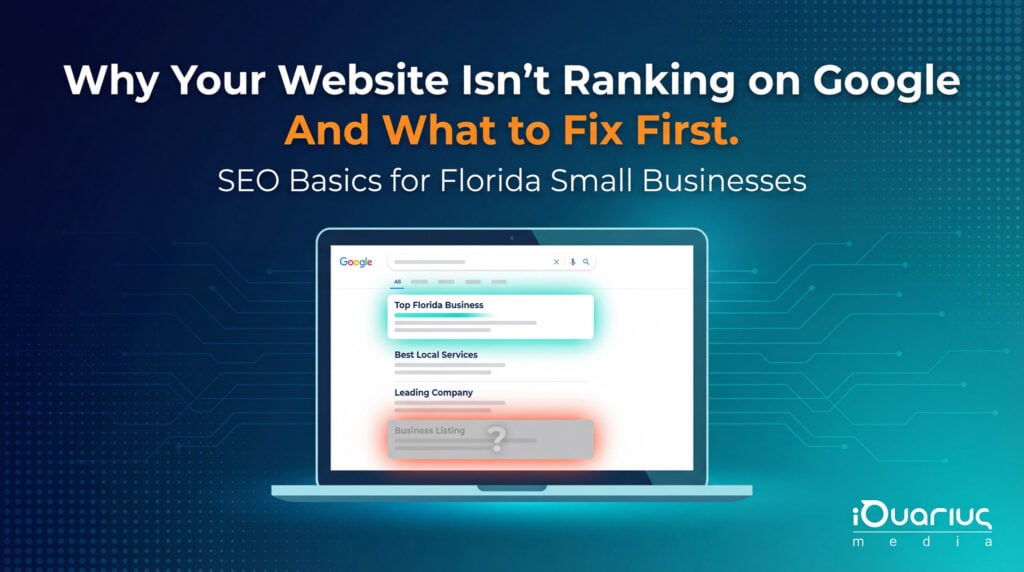
If your website isn’t showing up on Google, you’re not alone — and in most cases, you’re not dealing with a mystery. There are a handful of specific, diagnosable reasons why a site fails to appear in search results, and the majority of them are fixable without a complete overhaul. The key is knowing where to look first.
This post walks through the most common causes, how to identify which one is affecting your site, and what to prioritize when you’re ready to do something about it.
Google Has to Find Your Site Before It Can Rank It
Before any conversation about rankings, there’s a more fundamental question: does Google actually know your website exists?
Google discovers websites through a process called crawling. Its bots follow links across the internet, find pages, and add them to its index — a massive catalog of content it draws from when someone runs a search. If your site isn’t in that index, it cannot rank for anything, period.
You can check this in about ten seconds. Go to Google and type site:yourwebsite.com into the search bar. If pages appear, Google has indexed your site. If nothing appears, that’s your starting point, and it tells you the problem isn’t a rankings issue — it’s an indexation issue, which is a different problem with different solutions.
The most common indexation problems are:
- A “noindex” tag that was accidentally left on the site after development
- A robots.txt file blocking Google’s crawlers
- A brand new site that simply hasn’t been discovered yet
All three are correctable. A noindex tag or robots.txt block is often a developer oversight — something set intentionally during the build that never got removed before launch. If you’re not sure how to check for these, Google Search Console is the right tool. It’s free, it connects directly to how Google sees your site, and it will tell you plainly whether your pages are indexed and flag any crawl errors it encounters.
If Google Can Find You, the Next Question Is Why You Aren’t Ranking
Assuming your site is indexed, the reason you’re not appearing in search results almost always comes down to one of three things:
- Your content doesn’t match what people are actually searching for
- Your site doesn’t have enough authority for Google to trust it over established competitors
- There are technical problems slowing the site down or creating a poor user experience
Often it’s a combination of all three.
The content problem is the most common one for small businesses, and it tends to stem from a fundamental misunderstanding of how search works. Most business owners describe their services the way they think about them internally — using industry terminology, brand language, or phrasing that makes complete sense to them but doesn’t match how their customers are actually typing into Google. If someone in Orlando is searching “emergency AC repair near me” and your page talks about “residential HVAC solutions,” Google may not connect those two things strongly enough to rank you. Your content has to be written around the language your customers use, not the language your industry uses.
Authority is the harder problem to solve quickly, and it’s worth being honest about that upfront. Google’s ranking system is partly a trust system, and trust is built over time through what’s called backlinks — other websites linking to yours. When reputable sites link to your content, Google interprets that as a vote of confidence. A brand new website with no backlinks is starting at zero credibility in Google’s eyes, regardless of how good the content is. That’s not a reason to panic, but it is a reason to have realistic expectations about how long organic ranking improvement takes. For most competitive local markets in Florida, meaningful movement on organic search results takes three to six months of consistent effort minimum.
Technical problems are the most often overlooked because they’re invisible to the business owner. A site that loads slowly, renders poorly on mobile, has broken internal links, or has duplicate content issues can rank significantly below its potential even when the content and authority fundamentals are solid. Google has been explicit that page experience — loading speed, mobile usability, visual stability — is a ranking factor. A site that takes five seconds to load on a phone is going to lose rankings to a comparable competitor whose site loads in one.
The Local SEO Layer Most Florida Businesses Are Missing
For service businesses in Florida, there’s an additional dimension to this that’s worth addressing directly: local SEO and general organic SEO are not the same thing, and they require different strategies.
When someone searches “digital marketing agency Orlando” or “plumber near me,” Google doesn’t just pull from its general organic index. It consults local signals to determine who surfaces in the map pack and local results, including:
- Your Google Business Profile
- Citations across directories
- Reviews
- Proximity to the searcher
- Local relevance signals on your website
A business can have a technically sound website that ranks reasonably well nationally but still be invisible to people searching in its own backyard because the local signals haven’t been built out.
If you’re a Florida business trying to get found by customers in your city or service area, your Google Business Profile is not optional. It needs to be claimed, fully completed, actively maintained with photos and posts, and accumulating real reviews on a consistent basis. Your website also needs to speak the language of your geography — not in a forced, keyword-stuffed way, but in the organic way that local content naturally incorporates service areas, neighborhoods, and regional context.
This is the layer where a lot of well-meaning DIY SEO efforts fall short. The on-page basics get addressed, the Google Business Profile gets set up and then neglected, and six months later the business owner is frustrated that nothing changed. Local SEO is not a setup task — it’s an ongoing system.
What to Fix First: A Practical Priority Order
If you’re standing at the beginning of this problem, here’s where to put your energy in order of priority.
Start with Google Search Console. If you don’t have it set up, do that today. It’s the ground truth for how Google sees your site, and everything else you do will be more informed by having it. Check your index coverage, look for crawl errors, and verify that your key pages are being indexed properly.
Once you’ve confirmed indexation isn’t the problem, audit your content with fresh eyes. Pull up your most important service or product pages and ask honestly whether they’re written around the terms your customers search, or the terms you prefer. If you can’t answer that confidently, a keyword research tool like Google’s free Keyword Planner or a basic Ahrefs or Semrush check will show you the actual search volume behind different phrases.
From there, run your site through Google’s PageSpeed Insights tool to get a read on your technical performance. Pay particular attention to your mobile score — in Florida’s mobile-heavy market, a poor mobile experience is a significant competitive disadvantage.
If you’ve checked all of those boxes and you’re still not gaining traction after a few months, the issue is most likely authority and link equity. That’s when the conversation shifts from fixes to strategy — building content worth linking to, earning local citations, and developing the kind of credible online presence that Google interprets as trustworthy over time.
Frequently Asked Questions
Why is my website not showing on Google at all?
The most common reasons are that your site hasn’t been indexed yet, a noindex tag or robots.txt file is blocking Google from crawling it, or the site is too new to have been discovered. Check by typing site:yourwebsite.com into Google. If no results appear, use Google Search Console to diagnose the issue.
How long does it take for a website to show up on Google?
A new website can take anywhere from a few days to several weeks to be indexed after Google discovers it. Ranking competitively for meaningful search terms typically takes three to six months of consistent SEO work, and longer in competitive markets.
What is the difference between indexing and ranking?
Indexing means Google has found and cataloged your page. Ranking means Google is choosing to display that page in search results for specific queries. You have to be indexed before you can rank, but being indexed doesn’t guarantee you’ll rank well.
Does having a Google Business Profile help my website rank?
Directly, they’re separate systems — your Google Business Profile influences your visibility in local map results, while your website’s SEO influences your organic ranking. That said, they reinforce each other, and a well-optimized Google Business Profile is essential for any Florida service business trying to attract local customers.
What is the fastest way to improve my Google ranking?
There’s no shortcut that lasts, but the highest-leverage starting points are:
- Fixing technical issues that are actively suppressing your site
- Improving content to match real search queries
- Ensuring your Google Business Profile is fully optimized
These changes can show results faster than authority-building work, which takes more time by nature.
Can I fix my SEO myself, or do I need an agency?
Foundational fixes — checking indexation, cleaning up technical errors, improving content — are things a business owner can handle with some guidance. A sustained SEO strategy that builds authority and produces consistent ranking improvements over time is where a professional partner typically creates more value than the time and trial-and-error cost of doing it solo.
The Bottom Line
Getting found on Google isn’t luck, and it isn’t magic. It’s a diagnostic process — checking the right things in the right order, making informed improvements, and staying consistent long enough for the effort to compound. Most businesses that feel invisible online have specific, solvable problems standing between them and better visibility. The work is finding them.
If you’d like a professional set of eyes on why your site isn’t ranking — and a clear plan for what to do about it — iQuarius Media works with Florida businesses to build search visibility that actually drives leads.