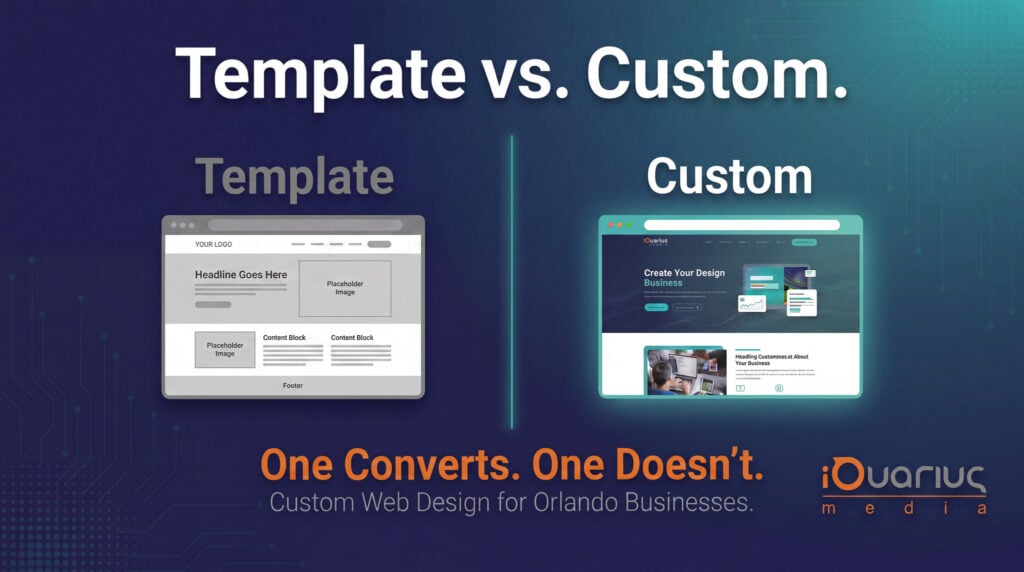
The question comes up in almost every web project conversation: do I really need a custom website, or will a template get the job done? It’s a fair question, and the honest answer is that it depends on what you’re asking your website to do. A template can absolutely serve some businesses well. For others, it’s a ceiling that limits growth from day one. Knowing which situation you’re in is the difference between a smart investment and an expensive mistake in either direction.
This post breaks down the real differences between custom web design and template-based sites — not from a design philosophy standpoint, but from a conversion and business performance standpoint.
What the Distinction Actually Means
A template-based website is built on a pre-designed framework — Squarespace, Wix, a WordPress theme from ThemeForest, a Webflow template. The structure, layout logic, and visual hierarchy are already determined. You’re populating someone else’s decisions with your content. That’s not inherently a problem. The problem is when the template’s decisions don’t align with your customers’ behavior, your conversion goals, or your brand’s position in the market.
Custom web design starts from your business objectives and works outward. The layout, information hierarchy, conversion paths, and visual language are built specifically around what your customers need to see, in what order, to move from interested to committed. Nothing is inherited from a framework designed for a generic business in a generic industry.
The distinction matters most at the conversion layer — the moments where a visitor decides to call, fill out a form, make a purchase, or leave. Templates make assumptions about those moments. Custom design makes decisions.
The Conversion Gap Is Real, and It’s Measurable
Template sites tend to convert at lower rates than well-executed custom sites, and the reason isn’t aesthetic — it’s structural. Templates are designed to work adequately for a wide range of businesses, which means they’re optimized for none of them. The call-to-action placement, the form length, the trust signals, the page flow — all of it reflects a compromise between competing use cases rather than a deliberate choice made for your specific customer.
When a professional web design agency builds a custom site, conversion rate optimization is baked into the architecture from the beginning. The primary CTA is placed where eye-tracking and scroll behavior data suggest it will perform. The contact form asks only the questions necessary to qualify a lead, not every question the business owner wanted to include. The trust signals — testimonials, credentials, case studies — appear at the moments in the page where skepticism typically peaks, not wherever the template happened to put a widget zone.
For Florida small businesses competing in markets where the difference between a 2% and a 4% conversion rate translates directly into revenue, that structural gap compounds significantly over time. A site that converts at double the rate on the same traffic volume is effectively doubling the return on every other marketing dollar spent — every SEO investment, every Google Ads dollar, every social media effort.
Where Templates Make Sense — and Where They Don’t
Templates are a reasonable choice in a narrow set of circumstances:
- A very early-stage business validating a concept before committing to infrastructure
- A business with a simple online presence need and no meaningful competition for digital leads
- A situation where budget constraints are genuinely prohibitive and the alternative is no website at all
Outside of those circumstances, the economics of templates are less favorable than they appear upfront. The low initial cost masks the ongoing cost of underperformance. A $500 template that generates half the leads of a $5,000 custom site is not the more affordable option over a 24-month period — it’s the more expensive one, because the gap in revenue generated dwarfs the gap in upfront investment.
There’s also a category problem. Your website communicates something about your business before a visitor reads a single word. A template-based site — particularly one a savvy buyer recognizes as an off-the-shelf theme — signals a certain level of investment in your own business. For professional services firms, B2B companies, and any business where trust and credibility are primary buying factors, that signal matters. It’s not vanity. It’s positioning.
WordPress web design done well occupies a middle ground worth acknowledging. WordPress as a platform is not a limitation — it powers a significant portion of the web’s highest-performing sites. The question is whether you’re running a purchased theme with minimal customization or a professionally developed WordPress build engineered to your specifications. The former is a template. The latter is effectively custom, built on a platform with an exceptional ecosystem.
User Experience Is Not a Design Amenity
One of the most persistent misconceptions about web design is that user experience is the aesthetic layer — the colors, the fonts, the imagery. It isn’t. User experience is the functional architecture of how a visitor moves through your site and whether that movement leads them toward a decision or away from one.
Good UX on a small business website means a visitor who arrives from a Google search can immediately confirm they’re in the right place, understand what you do and who you serve, find a reason to trust you, and take an action — all within the first 30 seconds of the visit. Most template sites fail this sequence at step three. They have adequate “about” information and a visible phone number, but the trust layer is thin and the transition from interest to action is unclear.
Custom web design for a service business in Orlando, for example, would be engineered around the specific trust signals that Central Florida customers weight heavily — local market knowledge, recognizable client names or industries, verifiable social proof, and a contact experience that doesn’t feel like submitting a ticket into a void. Those specifics can’t be templated. They have to be designed.
Landing page design is where the custom versus template distinction is sharpest. If you’re running paid traffic — Google Ads, Meta Ads, LSAs — your landing page is doing high-stakes conversion work with expensive visitors. A generic template landing page is a poor destination for that traffic. A custom landing page built around the specific offer, the specific audience, and the specific objections of a paid campaign can lift conversion rates dramatically. The math on that improvement pays back fast.
What Custom Web Design Actually Costs in 2026
Web design cost is the objection that sends most businesses toward templates, and it deserves a direct answer rather than the vague ranges that tend to populate this conversation.
For a professionally designed custom website for a Florida small business — five to fifteen pages, custom visual design, mobile optimization, basic on-page SEO, contact and lead capture functionality — expect a range of $4,000 to $12,000 depending on complexity, the number of custom features, and the agency. Enterprise builds, e-commerce development, and complex functionality push that number higher.
That range sounds significant until you model what the site is supposed to generate. A service business closing $5,000 average projects needs two or three incremental leads per month attributable to an improved website to recover a $6,000 investment within a quarter. For most businesses with real demand in their market, a well-built custom site produces that improvement. For businesses whose current site is actively suppressing conversions through poor UX or lack of credibility signals, the improvement is often larger and faster.
The conversation worth having isn’t “can I afford a custom website?” It’s “what is my current website costing me in leads I’m not converting?” For most established Florida small businesses, the second number is larger than they realize.
Frequently Asked Questions
What is the main difference between a custom website and a template?
A template is a pre-built design framework you populate with your content. A custom website is designed from the ground up around your business objectives, customer behavior, and conversion goals. The practical difference shows up in conversion performance, brand credibility, and long-term flexibility.
Do custom websites actually convert better than templates?
Generally, yes — particularly for service businesses where trust, clarity, and a strong conversion path are the primary drivers of lead generation. The performance gap comes from structural decisions: where CTAs are placed, how trust signals are presented, how the page flow guides a visitor toward action. Templates make assumptions about these decisions; custom design makes deliberate choices.
What does a custom website cost for a small business in Florida?
A professionally designed custom website for a Florida small business typically ranges from $4,000 to $12,000 depending on scope and complexity. E-commerce builds and sites with custom functionality run higher. The relevant question is not the upfront cost in isolation but the return on that investment relative to what a better-converting site generates over time.
Is WordPress a template or a custom platform?
Both, depending on how it’s implemented. A purchased WordPress theme with minimal customization is effectively a template. A professionally developed WordPress site built to custom specifications is a custom build — and a strong one, given the platform’s flexibility, SEO capabilities, and ecosystem.
How important is mobile design for a Florida small business website?
Critical. Florida has one of the highest smartphone usage rates in the country, and the majority of local searches happen on mobile devices. A site that performs poorly on mobile is losing leads in the moments of highest intent — near me searches, local queries, paid ad clicks. Mobile performance is not optional.
How do I know if my current website is hurting my conversion rate?
If your site receives reasonable traffic but generates few inquiries, the conversion rate is the problem. Tools like Google Analytics will show you bounce rate, session duration, and pages per visit — patterns that reveal where visitors are disengaging. A site audit from a web design agency can identify the specific structural issues suppressing performance.
Your Website Is Either Your Best Salesperson or Your Most Expensive Liability
For Orlando businesses investing in digital marketing — SEO, paid ads, social media — the website is the destination where all of that investment either pays off or doesn’t. Getting that foundation right isn’t a luxury. It’s the prerequisite for everything else working.
If you want an honest assessment of whether your current site is performing at the level your business deserves — or a conversation about what a custom build would look like for your specific situation — iQuarius Media designs and builds websites for Florida businesses that are engineered to convert.
“`